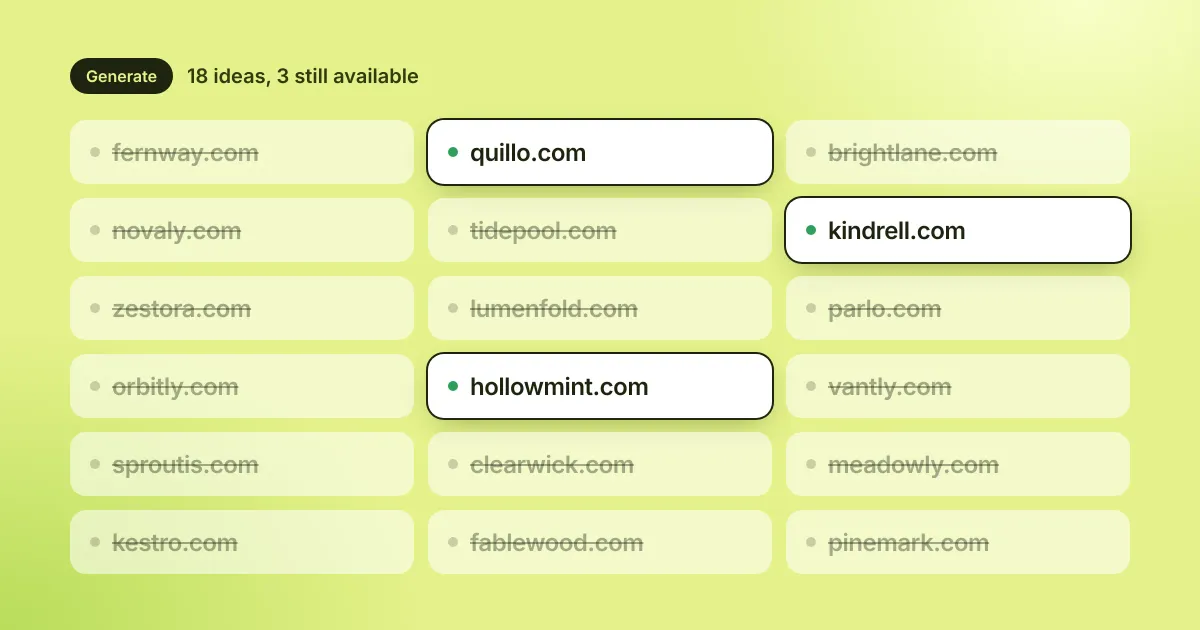
A domain name generator turns a few keywords into a list of names you could register. They range from simple tools that add words to your keyword and check the .com, to AI tools that invent brandable names from scratch. None of them is best at everything, so it helps to know what each one is for.
The short answer: for invented, brandable names, start with Namelix. For fast ideas with live availability across many extensions, use Instant Domain Search’s generator. For a .com built from real words, Lean Domain Search is quick and simple. Whichever you use, save your favourites somewhere and check them again before you buy, because a generator’s list is a snapshot.
We looked at each tool’s own pages in November 2026. Features change often, so check the tool before you rely on a detail.
The generators at a glance
| Generator | Uses AI | Checks availability | Extensions | Cost | Best for |
|---|---|---|---|---|---|
| Namelix | Yes | Yes | .com and others | Free; logos from $35 | Short, brandable invented names |
| Instant Domain Search | Yes | Yes, as you type | 800+ claimed | Free | Fast ideas across many extensions |
| NameMesh | Yes | Yes | Several | Free | Lots of variations grouped by style |
| GoDaddy | Yes | Yes, shows only available names | .com, plus others | Free | Quick ideas if you’ll buy at GoDaddy anyway |
| Shopify | Yes | Yes | Not listed | Free | Shop and ecommerce names |
| Lean Domain Search | No | Yes | .com and .blog only | Free | Real-word .com pairings |
| Domainr | No | Yes | Most extensions | Free search; paid API | Domain hacks and unusual extensions |
| Atom | Yes | Yes | Many | Free ideas; premium names cost thousands | Buying a ready-made premium name |
| ChatGPT or Claude | Yes | Only with a connector | Any | Free or subscription | Brainstorming with context about your product |
Namelix
Namelix is made by Brandmark, a logo design company. You enter a few keywords and choose a style, such as real words, compound words, invented words or rhymes, and it generates short, brandable names. You can filter by length and extension, and saving names you like steers the next batch toward similar ones.
Good: it’s the best of these at names that sound like brands rather than descriptions. Logo previews help you picture the name in use.
Less good: the best invented names are often taken in .com, and Namelix doesn’t keep checking names for you after you leave. Logos cost extra through Brandmark: $35, $95 or $195 as one-time payments.
We compare it with DomainIdea in more detail in DomainIdea vs Namelix.
Instant Domain Search
Instant Domain Search’s generator suggests available domains as you type, using AI, and checks them across a very large number of extensions. It’s free, needs no signup, and earns referral fees from registrars you click through to.
Good: speed. You can try dozens of starting words in a minute and see what’s free straight away.
Less good: the suggestions lean toward your keyword plus a word, rather than invented names. It doesn’t check trademarks.
NameMesh
NameMesh uses AI to generate names and groups them into categories like common, short, fun and similar, then checks availability. It’s free.
Good: the groups make it easy to see different kinds of name side by side.
Less good: it produces a lot of results, and many are long or awkward, so expect to scroll.
GoDaddy
GoDaddy’s free AI business name generator suggests names and says it only shows names with an available domain, mostly .com, with other extensions such as .store offered alongside.
Good: every suggestion can be registered right away.
Less good: it’s built to sell you a GoDaddy domain. Check the renewal price before you buy: GoDaddy’s standard .com renewal is around $23 a year, about double the cheapest registrars. Our post on .com renewal prices compares them.
Shopify
Shopify’s business name generator is free, needs no signup, and suggests AI-generated names with domain availability. It leans toward shop and product names.
Good: simple and quick for an online store.
Less good: registering a name leads into a Shopify trial, and it doesn’t say which extensions it checks.
Lean Domain Search
Lean Domain Search takes one word and pairs it with common words to find available domains. It’s run by Automattic, the company behind WordPress.com, and it’s free. It only covers .com and .blog.
Good: quick, no AI guesswork, and every result is a readable two-word name.
Less good: .com and .blog only, no numbers or hyphens, and the names are descriptive rather than brandable.
Domainr
Domainr is an instant domain search that also suggests domain hacks, where the extension completes the word, and names in unusual extensions. It’s now part of Fastly and mainly sells an API.
Good: the best place to find clever hacks and short names in less common extensions.
Less good: it’s a search tool more than a generator, so you need a starting word.
Atom
Atom, formerly Squadhelp, offers free AI name ideas, but its main business is a marketplace of premium, already registered brandable domains, plus naming contests and trademark screening.
Good: if you have a budget, you can buy a short, polished .com today instead of settling.
Less good: premium names usually cost thousands of dollars.
ChatGPT and Claude
General AI assistants are good at brainstorming because you can describe your product, audience and tone in detail. On their own, though, they can’t see which domains are registered, so many suggestions will be taken. ChatGPT can check domains through connectors from GoDaddy and Instant Domain Search (Instant Domain Search). Without one, paste the shortlist into a checker such as our free bulk domain availability checker.
What generators don’t do
Every generator gives you a list at one moment in time. Three things usually happen next, and generators don’t help with them:
- You need to choose. Say each name out loud, check it’s easy to spell, and look for trademarks in your market.
- Your favourite is taken. Instead of starting over, look for close variations: another extension, a short word added, or a new spelling. Our taken domain alternatives finder checks those in one go.
- You come back a week later. Names on your list may have been registered, and taken ones may be expiring. A list in a notes app won’t tell you.
That last step is what DomainIdea does on the Mac. It doesn’t generate names. It keeps the ones you’ve found, checks them across every extension you care about, suggests close available variations when one is taken, and watches taken domains until they drop. Our post on a simple system for capturing and choosing domain names explains the approach.
How to get a good name out of a generator
- Start with three to five words about what the product does and how it should feel, not just its category.
- Try more than one tool. They’re built differently, so they suggest different names.
- Shortlist fast, decide slow. Save anything you like, then come back the next day and cut the list to five.
- Check before you fall in love. Run the shortlist through a live availability check and a trademark search.
- Register the winner soon. An available name can be registered by someone else at any time.
FAQ
What is the best free domain name generator?
For brandable names, Namelix. For fast, broad availability checks, Instant Domain Search. Both are free. Lean Domain Search is the simplest for real-word .com names.
Are AI domain name generators better?
They’re better at inventing new, brandable words. Rule-based tools like Lean Domain Search are better when you want clear, descriptive names. Many people use one of each.
Can a generator tell me if a name is trademarked?
Mostly no. Namelix links to a USPTO search and Atom offers trademark screening, but you should still search the trademark database for your country and market yourself.
Why are so many generated names already taken?
Short, pronounceable .com names have been registered for years. Generators that show only available names filter those out, which is why their suggestions tend to be longer or invented.
Should I buy the domain from the generator’s registrar?
You don’t have to. You can register the name at any registrar. Compare renewal prices, not just the first year, because they vary by more than double.
Is it safe to search names in a generator?
Most generators send your keywords to their own servers and link to registrars. If you’re worried about your ideas being seen, our post on what “available” really means covers how searches work.