
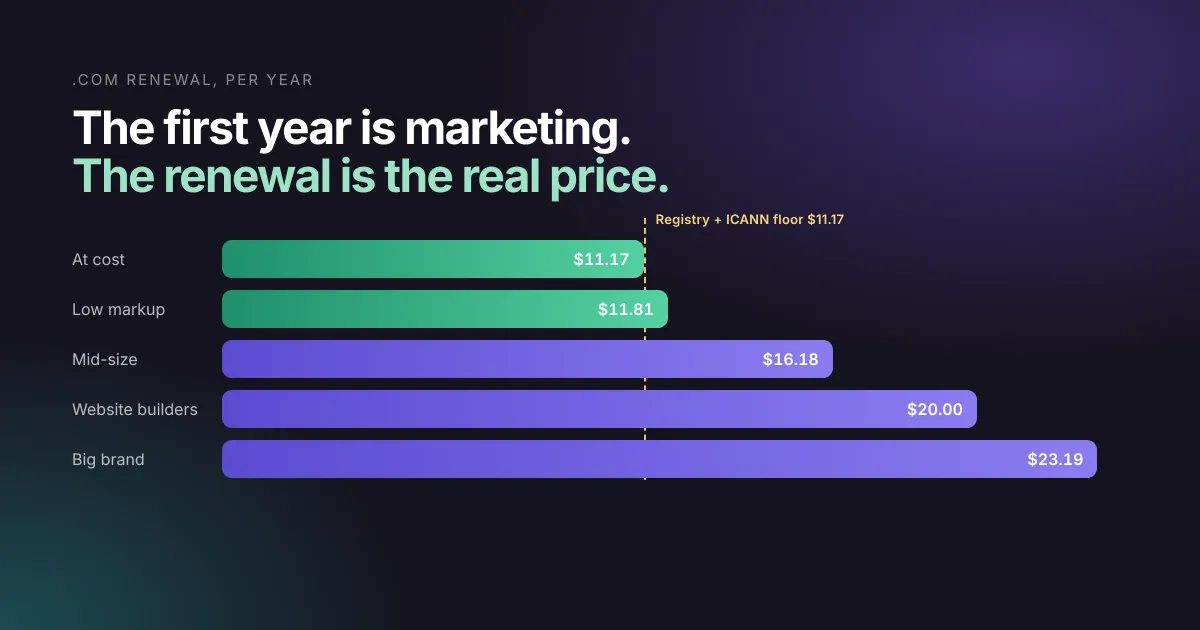
A .com that costs $0.01 today can cost $23 next year. The first-year price is a marketing number. The renewal price is what you pay for as long as you own the domain, and it varies by more than double between registrars.
The short answer: in November 2026 the cheapest .com renewals are about $11 to $12 a year, at registrars that sell close to cost, such as Cloudflare, Porkbun, Spaceship and Dynadot. The big consumer brands charge $16 to $23. Nobody can go much below about $11.17, because that’s what the registry and ICANN charge every registrar.
Where the price of a .com comes from
Every .com renewal has three parts:
| Part | Who sets it | Amount (November 2026) |
|---|---|---|
| Wholesale price | Verisign, which runs the .com registry | $10.97 a year |
| ICANN fee | ICANN, charged on each domain-year | $0.20 |
| Registrar markup | Your registrar | $0 to about $12 |
Verisign raised the wholesale price from $10.26 to $10.97 on 1 November 2026, a 7% increase, the first since 2024 (Domain Name Wire). Its contract lets it raise the price by up to 7% in each of the remaining years of this six-year cycle. If it uses every increase, the wholesale price would reach about $13.42 by the end of the cycle (Domain Name Wire, Webhosting Today). Whether it does is Verisign’s choice each year.
ICANN’s per-domain fee went from $0.18 to $0.20 on 1 July 2025 (Realtime Register). Some registrars include it in the price they show. Others, like Namecheap and GoDaddy, add it at checkout (Namecheap).
So $10.97 plus $0.20, or $11.17, is the floor. A registrar that charges less than that on renewal is losing money on you, which doesn’t happen for long.
.com renewal prices by registrar
These are standard renewal prices for one year, without coupons. Prices change often, so the table says where each one came from and when it was checked. Prices checked before 1 November were set before Verisign’s increase, and registrars that sell at or near cost will have gone up by about $0.71 since.
| Registrar | Renewal per year | First year | Free WHOIS privacy | Source, checked |
|---|---|---|---|---|
| Cloudflare | $11.17 (at cost) | Same as renewal | Yes | DomainOffer, 8 Nov 2026 |
| Spaceship | $10.88 | Promos from $3.18 | Yes | DomainOffer, 8 Nov 2026 |
| Dynadot | $10.88 | $10.88 | Yes | Datafume, 19 Oct 2026 |
| Porkbun | $11.81 | $11.81 | Yes | Porkbun, 8 Nov 2026 |
| NameSilo | $17.29, or about $11 with its free discount program | $17.29 | Yes | Datafume, 19 Oct 2026 |
| Namecheap | $15.98 plus the ICANN fee | Promos from $6.48 | Yes | DomainOffer, 8 Nov 2026 |
| Squarespace | $20.00 | About $10 | Yes | Datafume, 19 Oct 2026 |
| IONOS | $20.00 | $1 welcome offer | Not confirmed | Datafume, 19 Oct 2026 |
| Hostinger | $20.19 | From $0.01 with a multi-year plan | Yes | Datafume, 19 Oct 2026 |
| GoDaddy | $22.99 plus the ICANN fee | From $0.01 to $4.99 with conditions | On eligible extensions | DomainOffer, 8 Nov 2026 |
Spaceship and Dynadot sit slightly below the new floor in these listings, which almost certainly means their pages hadn’t caught up with the 1 November increase when they were checked. Expect them to land at or just above $11.17. Check the registrar’s own price page before you move anything.
Why the first-year price is misleading
Registrars compete for new customers on the first-year price because that’s what shows up in search results and comparison tables. They make the money back on renewals, which most people pay without looking.
A few patterns to watch for:
- The one-cent .com. GoDaddy and Hostinger have both offered a first year for a cent or close to it, usually tied to a multi-year term or a hosting plan. The renewal is then $20 or more.
- New customer only. Coupon codes are usually limited to one domain per new account.
- Multi-year lock-ins. Paying for three years up front at a promo price can be a good deal, but check what the total is, not the headline year.
- Privacy as an extra. Most registrars now include WHOIS privacy for free. If yours charges for it, add that to the renewal price.
Our Black Friday domain deals post goes through this year’s sales with the renewal prices next to each offer.
How much you’d save by moving
The difference looks small for one domain and large for a portfolio:
| Domains | At $22.99 + $0.20 a year | At $11.17 a year | Saved each year |
|---|---|---|---|
| 1 | $23.19 | $11.17 | $12.02 |
| 10 | $231.90 | $111.70 | $120.20 |
| 50 | $1,159.50 | $558.50 | $601.00 |
Moving a .com to another registrar is called a transfer. You pay the new registrar’s price for one year, and that year is added to your current expiry date, so you lose nothing you’ve already paid for. Two rules apply to every generic domain:
- You can’t transfer in the first 60 days after registering, or after a previous transfer.
- You need the transfer code (also called the auth code or EPP code) from your current registrar, and the domain must be unlocked.
Transfer before the domain enters its last month, not after it expires. Once a domain is past its expiry date, many registrars block transfers, and you may end up paying their renewal price anyway. If you’re not sure when your domains expire, the domain expiry checker shows the date for any domain.
When the cheapest registrar isn’t the right one
Price isn’t everything. A few reasons to pay more:
- You need DNS features your cheap registrar doesn’t have. Cloudflare’s at-cost pricing requires using Cloudflare’s DNS, which suits most people but not everyone.
- You want everything in one account. If your hosting, email and domains live together and that saves you time, a few dollars a year can be worth it.
- Support matters to you. Low-margin registrars often have slower support.
- The extension isn’t supported. Cheaper registrars often carry fewer country extensions.
For most people with a handful of .com domains, though, there’s no good reason to pay $20 or more a year when $11 to $12 gets the same domain, the same registry and the same expiry rules.
Keep an eye on renewal dates and costs
The reason renewal prices drift up unnoticed is that renewals are automatic and spread across the year. Write down three things for each domain: the registrar, the renewal date, and what it costs a year. A spreadsheet works if you keep it up to date.
DomainIdea does this on the Mac. Its Portfolio keeps your domains with their registrar, expiry date and annual renewal cost, adds up what your domains cost each year, and reminds you before each one renews. It’s a good moment to decide whether to keep a domain at all: our post on how domain expiration works explains what happens if you let one go.
FAQ
What is the cheapest registrar to renew a .com?
In November 2026, Cloudflare, Spaceship, Dynadot and Porkbun all renew .com for about $11 to $12 a year. Cloudflare charges exactly what the registry and ICANN charge, which is $11.17 after the 1 November increase.
Why did my .com renewal price go up?
Either your registrar raised its markup, or you’re renewing after a first-year promo ended. Verisign also raised the wholesale price by $0.71 on 1 November 2026, and most registrars pass that on.
Will .com prices keep rising?
Verisign may raise the wholesale price by up to 7% a year for the rest of its current pricing cycle. If it uses every increase, a .com would cost registrars about $13.42 wholesale by the end of the cycle.
Can I renew a .com for more than one year?
Yes. You can renew a .com for up to ten years in total. Renewing several years ahead also locks in today’s price for those years, which protects you from future increases.
Does transferring a domain cost extra?
A transfer costs the new registrar’s one-year price, and that year is added to your registration. You don’t lose the time you’ve already paid for.
Is it worth transferring one domain to save $10?
For one domain, maybe not, unless you’re moving other things anyway. For ten or more, the savings add up to over $100 a year, and a transfer takes a few minutes per domain.