
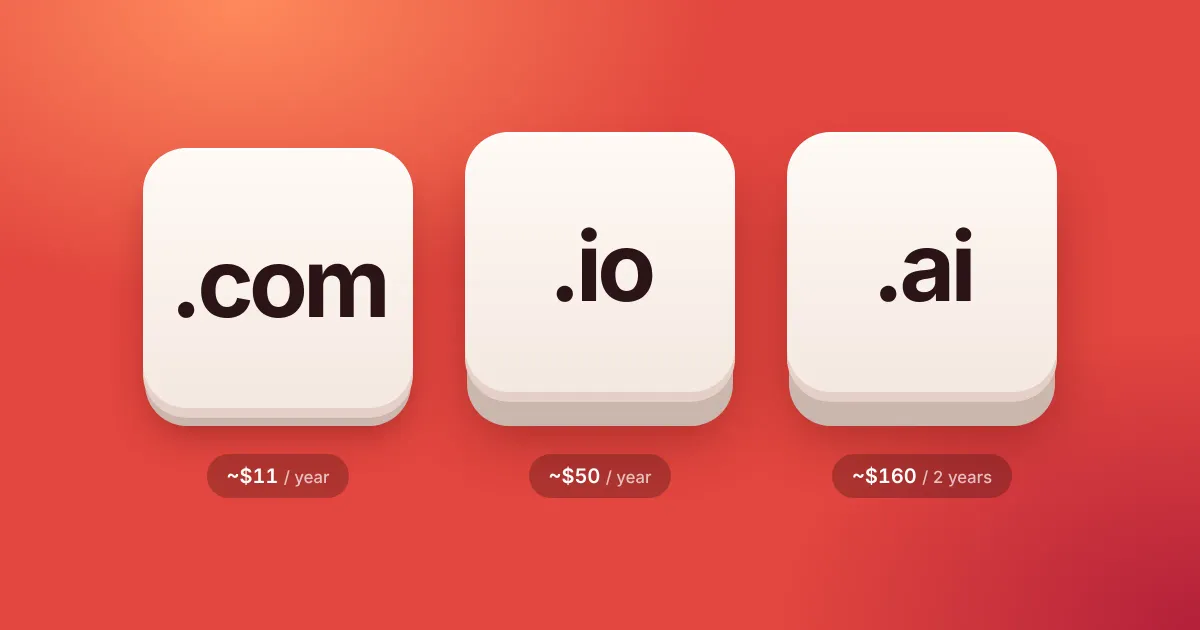
Most founders start with the .com, find it taken, and then wonder whether .io or .ai is good enough. The answer depends less on what’s fashionable and more on who needs to find you, what you can afford to renew every year, and how much risk you’re willing to carry.
The short answer: use .com if you can get a good one, because it’s what people type by default. For a developer tool or tech startup, .io, .app and .dev are fine and widely trusted. Use .ai only if your product really is AI, and budget about $80 a year, paid two years at a time. Whichever you pick, try to own the .com too, or at least know who does.
How they compare
Renewal prices are the lowest standard renewal at Cloudflare, Porkbun, Spaceship and Namecheap, from DomainOffer (checked 26 to 27 October 2026) and Porkbun (checked 8 November 2026), except .com, which is covered in what a .com really costs to renew.
| Extension | Lowest renewal a year | Run by | Best for | Watch out for |
|---|---|---|---|---|
| .com | About $11 | Verisign | Everyone, especially consumer products | Good short names are taken or expensive |
| .io | About $50 | Identity Digital, under the British Indian Ocean Territory | Developer tools, SaaS | Higher price; long-term question over the territory |
| .ai | About $80, two years at a time | Identity Digital, for the Government of Anguilla | AI products | Highest price; two-year minimum on every term |
| .co | About $30 | GoDaddy Registry, for Colombia | Startups, companies | Easily mistyped as .com |
| .app | About $14 | Google Registry | Apps and web apps | HTTPS is required |
| .dev | About $12 | Google Registry | Developer tools, personal sites | HTTPS is required |
.com: still the default
People type .com without thinking. When someone hears your name on a podcast or reads it on a sticker, they’ll try the .com first, and if that’s someone else’s site, you’ve lost the visit. It’s also the cheapest of the popular extensions to keep: about $11 a year at registrars that sell close to cost.
The problem is availability. Almost every short, real-word .com is registered. That leaves three routes:
- Add a word. Names like getacme.com or acmehq.com are normal for startups, and many companies have moved to the plain .com once they could afford it.
- Buy it. If the .com is parked, the owner may sell. Our guide to buying a domain that’s already taken covers offers, brokers and escrow.
- Use another extension and accept the trade-offs below.
Our free taken domain alternatives finder checks all three kinds of variation for your name in one go.
.io: the developer favourite
.io is the country code of the British Indian Ocean Territory, but it has been used as a generic tech extension for over a decade. Developers and investors recognise it, and Google treats it as a generic extension for search, not as a country one.
It costs about four to five times as much as a .com to renew, around $50 a year at the cheaper registrars.
The bigger question is the territory itself. In 2024 the UK agreed to hand sovereignty over the Chagos Islands, which make up the territory, to Mauritius. If the territory stops existing and its country code is withdrawn, ICANN’s rules for retiring a country code extension would give .io a transition of five years, extendable to ten (Domain Incite). In April 2026 the UK froze the plan because the US had not given its formal consent, and Domain Incite described .io as “safe for now” (Domain Incite).
In practice: .io is not going away overnight, and even in the worst case there would be years of notice. But if you’re building something you expect to run for twenty years, it’s a reason to also own a .com version of your name.
.ai: for AI products, at a price
.ai is Anguilla’s country code, and it has become the extension for AI companies. It passed one million registrations in January 2026 (Domain Incite).
It’s also the most expensive common extension:
- Two-year minimum. Every registration and every renewal is for at least two years (NameSilo).
- Rising price. The registry raised its wholesale price from $140 to $160 per two-year term on 5 March 2026 (Domain Name Wire).
- About $80 a year at retail, so $160 every time you renew. Spaceship, Cloudflare and Porkbun all charge close to that (DomainOffer, Porkbun).
.ai works best when “AI” really is what you do. If the product is a calendar app with one AI feature, the extension can date quickly, and you’ll be paying a premium for it every two years.
.co, .app and .dev
- .co reads like “company” and is often used by startups. Its weakness is that it’s one letter away from .com, so some of your visitors and some of your email will go to the .com owner by mistake.
- .app and .dev are run by Google Registry and are on the browser HSTS preload list, so every site on them must use HTTPS (Google Registry, .app, Google Registry, .dev). That’s a plus for security and makes no difference if your host sets up certificates automatically, which most do. Both are cheap to renew, at about $12 to $15 a year.
Does the extension affect SEO?
Not directly. Google treats generic extensions such as .app and .dev, and a list of country codes used generically, including .io, .ai and .co, the same as .com for ranking (Google Search Central). What it does affect is click-through and memory: people are more likely to click and remember a name in an extension they recognise.
A simple way to decide
- Check the .com first. If you can get a good one for your name, take it.
- If it’s taken, look at who has it. If it’s an active company in your market, pick a different name, not just a different extension. You’ll fight over visitors, email and possibly trademarks. The domain owner lookup shows who it’s registered with.
- If it’s parked or unused, use a prefix or suffix on the .com, or one of the extensions that fits your product: .io or .dev for developer tools, .app for apps, .ai for AI products.
- Add up five years of renewals, not the first-year price. Five years of .com is about $56. Five years of .ai is about $400.
- Keep an eye on the .com. If you settle for another extension, watch the .com in case it ever expires. Our post on getting notified when a domain becomes available explains how.
DomainIdea for Mac checks a name across all of these extensions at once, saves the ones you like, and watches the taken ones so you know if your first choice ever frees up.
FAQ
Is .io still safe to use?
Yes, for now. The plan to hand the Chagos Islands to Mauritius was frozen in April 2026. Even if the territory’s code were withdrawn, ICANN’s process would give .io owners at least five years to move. Owning a .com version of your name is a sensible backup.
Why are .ai domains so expensive?
The registry charges $160 per two-year term since March 2026, so registrars can’t go much below about $80 a year. Demand from AI companies has kept the price high.
Is .co a good alternative to .com?
It’s fine for a company that will mostly be found by search and links. It’s weaker if people will type your address from memory, because many will type .com by habit.
Do investors care about the extension?
Most don’t, as long as the name is clear and you control your brand. A .io or .ai is normal for an early-stage tech startup. Some founders buy the .com later when they can afford it.
Which extension is cheapest to renew?
Of the common startup extensions, .com is the cheapest at about $11 a year, followed by .dev and .app at about $12 to $15. .co costs about $30, .io about $50 and .ai about $80.
Should I register my name in several extensions?
Register the ones you’ll actually use, plus the .com if it’s free. Buying every extension gets expensive at renewal time and rarely stops anyone who’s determined to copy you.