
When a domain you want is about to be deleted, you’ll quickly run into the word “backorder”. It sounds like reserving a product that’s out of stock. It’s closer to hiring someone to stand at the door at the exact moment the shop opens, along with everyone else who hired someone too.
The short answer: a backorder asks a drop-catching service to try to register a domain the instant the registry deletes it. Most services only charge if they catch it. If more than one person backorders the same name at the same service, it goes to an auction. A backorder is worth it for a name that’s already in redemption or pending delete and that other people are likely to want. It’s a waste of time for a domain that’s simply expiring soon, because most of those are renewed.
What happens when a domain drops
A domain that isn’t renewed doesn’t disappear on its expiry date. For .com and most generic extensions, it goes through an auto-renew grace period of up to 45 days, a 30 day redemption period, and five days of pending delete before the registry deletes it. We cover each stage in how domain expiration works.
At the end of pending delete, the registry releases the name, and anyone can register it. For .com, Verisign releases deleted names in a batch at roughly the same time each day. Within that window, the first registration request to arrive wins.
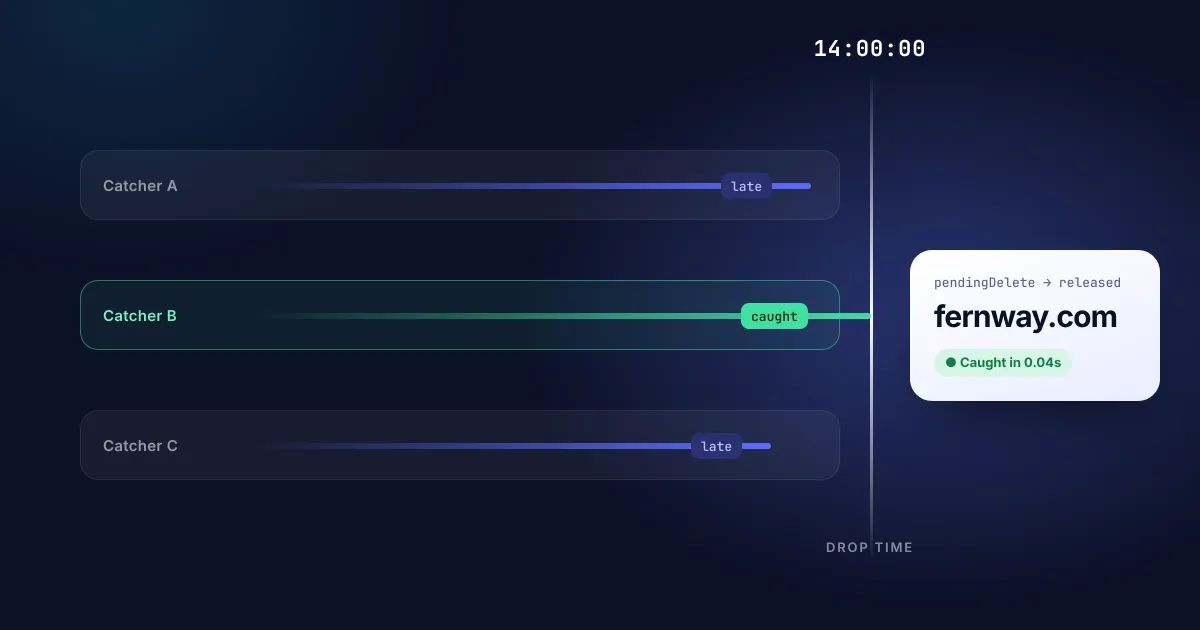
Ordinary registrars aren’t built to win that race. Drop-catching services are. They hold accreditation at many registrars, each with its own connection to the registry, and send registration requests through all of them at the moment of release. For a name with any value, the race is usually over in well under a second.
What a backorder actually is
A backorder is your instruction to one of those services to try for a specific name. In practice:
- You place the backorder on a name that’s expiring. With most services this is free or needs only an account with funds.
- The service tries to catch it when it drops.
- If it catches the name and you’re the only backorder, you pay the service’s catch fee and the domain is registered to you, usually with a year included.
- If several people backordered it at the same service, the caught name goes to a private auction between them. The starting bid is usually the catch fee.
- If the service doesn’t catch it, you usually pay nothing, and the name goes to whichever service or person did.
A backorder doesn’t stop the owner from renewing. If the owner renews or restores the name, or the registrar sells it at an expired domain auction first, it never drops, and the backorder simply doesn’t happen.
The main backorder services
These are the names you’ll come across most:
| Service | How it charges | Notes |
|---|---|---|
| DropCatch | Free to place, pay only if caught | One of the biggest catchers, with hundreds of registrar connections. Competing backorders go to auction. |
| NameJet | Free to place, pay only if caught | Also handles names released by its partner registrars before they drop. |
| SnapNames | Free to place, pay only if caught | Long-running service, run by the same group as NameJet. |
| Dynadot | Pay only if caught | Needs a small account balance. Competing requests go to a backorder auction. |
| Your own registrar | Varies | Some registrars offer backorders, often with lower fees and lower success rates. |
Catch fees change, so check each service’s current price before you place a backorder. As a rough guide, the big drop-catching services have long charged a catch fee of tens of dollars per name, and registrar backorders often cost less.
One big name is missing from the list. GoDaddy stopped selling backorders and domain monitoring on 7 October 2025. It now points customers to GoDaddy Auctions for expired names, and suggests third-party tools for monitoring. If you remember placing backorders at GoDaddy, they no longer exist.
When several people want the same name
This is where backorders get expensive. If a name is good enough that you want it, others may too.
- At the same service, the backorders become an auction. You’ll compete with everyone else who backordered there, and the price can go far above the catch fee.
- At different services, they race. Only one service catches the name, and only its customers get a chance at it.
That’s why people backorder valuable names at several services at once. It raises the chance that whichever service catches the name is one you’re with. The cost is that you might end up in an auction at that service anyway. Since most services charge only on success, placing several backorders costs nothing unless one of them succeeds.
When a backorder is worth it
| Situation | Backorder? |
|---|---|
| Domain in pending delete | Yes, if you want it. It drops within days. |
| Domain in redemption | Yes. The owner can still restore it, but if they don’t, it drops in about five weeks. |
| Expired, in grace period | Not yet. Most are renewed or auctioned by the registrar. Watch it. |
| Registered, expires in months | No. Almost all are renewed. Contact the owner if you want it now. |
Valuable short or keyword .com |
Yes, at several services. Expect an auction. |
| Obscure name nobody else wants | One backorder is plenty. You might even register it by hand after it drops. |
Not sure which stage a domain is in? Our free expiry and drop-date checker shows it from the registry’s own data, with an estimated drop date.
Why many expiring domains never drop
Plenty of people place a backorder on an expiring .com and hear nothing for months. That’s normal, for three reasons:
- Owners renew late. The expiry date passes, the website and email stop working, and the owner pays up during the grace period.
- Registrars auction expired names. Most registration agreements let the registrar sell an expired name during the grace period. Names with traffic or a good keyword often go to an auction winner and never reach redemption.
- Owners restore from redemption. It costs them a restore fee, but people who meant to keep a domain will pay it.
So the signal to act on isn’t the expiry date. It’s the status changing to redemptionPeriod, then pendingDelete.
A simple backorder plan
- Write down what the name is worth to you. If it goes to auction, you’ll want to know your limit before the bidding starts.
- Watch the domain’s status, not just its date. Don’t place backorders on names that are merely expiring.
- Place backorders once it enters redemption. That leaves plenty of time before the drop. For a valuable name, use more than one service.
- Check the auction rules at each service, including how long auctions run and when you have to pay.
- Have a backup name ready, in case the domain is restored or someone else catches it.
DomainIdea’s watchlist handles step 2. Add a domain to the Mac app and it follows the registration status for you, estimates the drop date, checks more often as the drop gets close, and sends a notification when the domain changes stage. That way you’ll know the day it enters redemption, which is when a backorder starts to make sense.
FAQ
Do I pay for a backorder if it fails?
At most drop-catching services, no. You pay only if the service catches the name. Some registrars charge up front and refund or credit you if they fail, so read the terms.
Can a backorder stop the owner from renewing?
No. The owner can renew during the grace period and restore during redemption. A backorder only matters if the domain is actually deleted.
How long does a backorder take?
It runs until the domain drops, which could be days or never. Once a name is caught, it’s usually in your account within a day or two, unless it goes to auction.
Should I backorder at more than one service?
For names others will want, yes. Only one service will catch the domain, so being with several raises your chances. For obscure names, one is enough.
Can I just register a domain myself when it drops?
For names nobody else wants, often yes. Many names drop and are still available hours or days later. For anything with value, drop-catching services will beat a manual registration every time.
Sources
Checked on 3 November 2026.
- How to backorder a domain name (Dynadot, updated 1 June 2026)
- What is a backorder (drop catch)? (Dynadot)
- Announcing a deadline extension for backorders (GoDaddy, backorders and monitoring end 7 October 2025)
- How to backorder a domain name (NameSilo)
- Expired Registration Recovery Policy (ICANN, 30 day redemption period)