
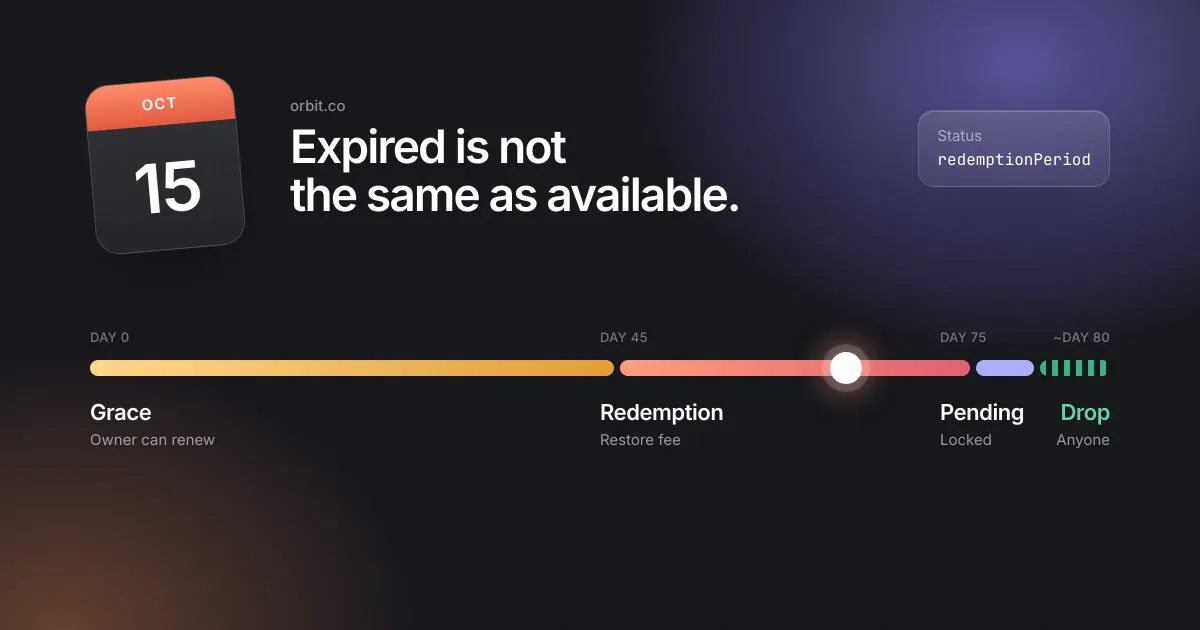
You’ve found the perfect name, and someone already owns it. Then you notice the expiry date is next month. It’s tempting to set a reminder and plan to register it the day after. In practice, it almost never works that way.
A registration doesn’t end on its expiry date. It moves through a series of stages that can take more than two months, and at several points along the way the name can be renewed, restored, or sold before you ever get a chance at it. Knowing those stages helps you judge which names are worth waiting for, and when to pay attention.
The short version
For most generic top-level domains (.com, .net, .org, .app, .dev, and most of the newer extensions), the lifecycle after expiry looks roughly like this:
| Stage | Typical length | Can the owner keep it? | Can you register it? |
|---|---|---|---|
| Expired / renewal grace | 0 to 45 days | Yes, at the normal renewal price | No |
| Redemption | 30 days | Yes, with a restore fee | No |
| Pending delete | 5 days | No | No |
| Dropped | Yes, first come, first served |
Add those up and a name that expires today usually becomes available about 75 to 80 days later, if it becomes available at all. Each stage is worth a closer look.
Stage 1: Expiry and the renewal grace period
On the expiry date, nothing dramatic happens at the registry. For many extensions, including .com, the registry renews the domain automatically and gives the registrar a window, up to 45 days, to either collect payment from the owner or delete the name and get a refund. This is called the auto-renew grace period.
What the owner experiences depends on their registrar. ICANN’s expired registration policy requires registrars to give owners at least 30 days after expiry to renew, and to interrupt the domain’s website and email for part of that time so the owner notices. That’s why an expired domain often shows a registrar’s “this domain has expired” parking page instead of its old site.
During this stage the owner can renew at the normal price, and plenty do, often when their email stops working. A lot of names you see “expiring” never get past this point.
There’s a second thing happening here that surprises people: many registrars auction expired names during the grace period. Their registration agreements typically allow them to, and an expired name with traffic or a good keyword can be sold to an auction bidder well before it would ever be released. If the original owner doesn’t renew, the auction winner takes over the registration, and the name simply never drops.
Stage 2: Redemption
If the registrar deletes the name at the end of its grace period, it enters a 30 day redemption period. The domain stops resolving entirely. The registry still holds it, and the original owner can get it back, but only by paying a restore fee on top of the renewal. Restore fees vary by registrar and are often far more than the renewal itself.
In registration data, you’ll see the status redemptionPeriod. This is the first point where a name is genuinely on its way out. Owners who meant to keep a domain usually restore it here once they realize what’s happened, so a name in redemption is a much stronger signal than a name that’s merely expired.
Stage 3: Pending delete
After redemption comes a five day pending delete period, shown as the status pendingDelete. Nobody can renew or restore the name now, not even the original owner. At the end of those five days the registry deletes it, and it becomes available to register.
For popular extensions, deletions happen in a batch at a predictable time of day. That’s when the drop-catching services compete. They hold many connections open to the registry through many accredited registrars and try to register valuable names the instant they’re released. If a name has any obvious value, a backorder service will usually get it before a person typing into a registrar’s search box can.
Why ccTLDs are different
Country code extensions like .co, .io, .uk, or .de set their own rules, and they vary a lot. Some have shorter grace periods, some have no redemption period, some release names on a different schedule, and some go straight to a registry auction. If you’re watching a country code domain, check that registry’s own policy rather than assuming the generic timeline.
How to read the signals
You can’t know for certain whether a name will drop, but registration data tells you a lot about where it is in the process. A few patterns are worth recognizing:
- The expiry date moved forward a year. The owner renewed, or the registry auto-renewed it at the start of the grace period. Check the status before you read too much into it.
- Status shows
autoRenewPeriodor a registrar hold. The name is in its grace period. The owner can still renew at the normal price, and the registrar may be auctioning it. - Status shows
redemptionPeriod. The registrar has let it go. It’s likely to drop in a little over a month unless the owner restores it. - Status shows
pendingDelete. It will drop within about five days. If it’s valuable, expect competition. - The registrar changed and the expiry date jumped. Someone won it at auction or bought it. Start over.
A sensible way to wait for a name
Waiting for a specific domain is mostly a matter of not missing the moment it changes. A few habits help:
- Write down why you want it. If you’re still waiting in three months, you’ll want to remember whether it was worth it, and what you’d pay for it if it turned up at auction.
- Check the status, not just the date. The expiry date alone tells you very little. The status codes tell you which stage it’s in.
- Check more often as it gets close. Once a name enters redemption, the timeline becomes fairly predictable. Checking daily is plenty before that, and more often near the expected drop is reasonable.
- Have a backup. Look at the same name in other extensions, or a variation, so you’re not stuck if it gets caught or renewed.
- For valuable names, consider a backorder. If a name has obvious commercial value, a backorder with a drop-catching service is often the only realistic way to get it at drop.
How DomainIdea helps
DomainIdea’s watchlist does this checking for you. It reads a domain’s registration data through RDAP, the modern replacement for WHOIS, and keeps a history of what changed. It estimates when a name is likely to drop from its expiry date and status, using the typical periods above (45 days of grace, 30 of redemption, and 5 of pending delete), which you can adjust in Settings for extensions that work differently. As a name gets close to its estimated drop, it checks more often and notifies you when the status changes.
It can’t make a name drop, and drop dates are always estimates. But it means you’ll find out that a domain entered redemption the day it happens, instead of a month later when it’s already gone.